
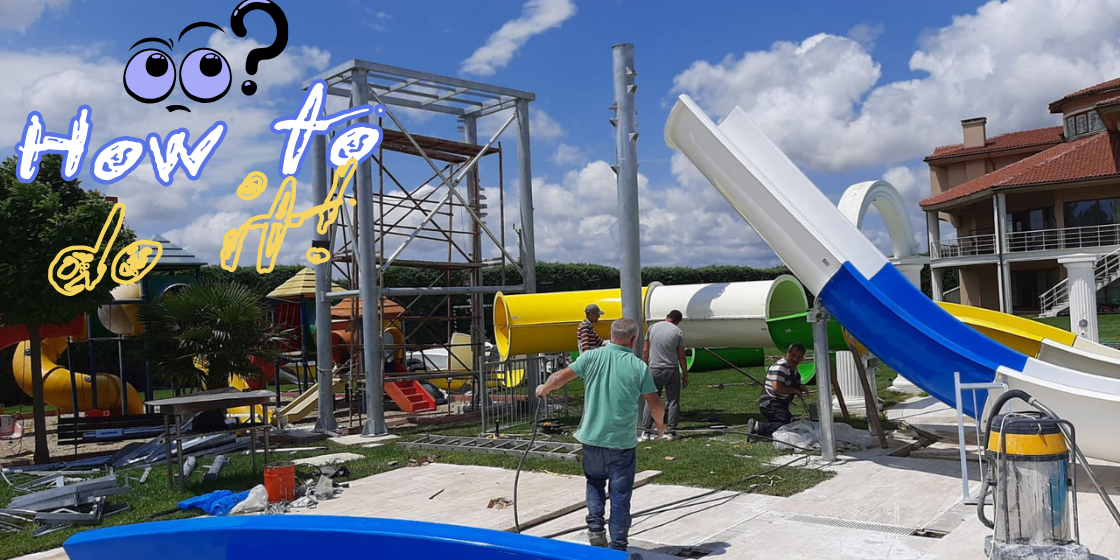
How Does the Water Slide Production Process Begin?
The journey of manufacturing water slides combines precision and creativity. It all starts with the design phase, where detailed drafts and blueprints are created. From these designs, a model is crafted, allowing for any necessary revisions. Once the model is finalized, the critical step of mold creation takes place, which forms the foundation for the final product. Using this mold, the production process truly comes to life.
Mold Preparation and Material Quality
A clean mold is the first step in ensuring a high-quality water slide. Release agents are applied to facilitate easy removal of the product from the mold. Following this, a layer of high-performance gelcoat in the desired color code is applied. This material not only enhances the water slide’s durability but also ensures resistance to chlorine, UV rays, cleaning chemicals, and water. Unlike some manufacturers who opt for lower-cost, standard gelcoats, Parcaqua exclusively uses high-performance gelcoats to provide exceptional longevity and reliability.
For customized water slides with intricate patterns or designs, these are skillfully integrated onto the mold. To avoid color inconsistencies, the gelcoat is applied in at least two layers, but never exceeding three layers, as excessive application may lead to cracking.
Fiber Reinforcement and Polyester Application
Once the gelcoat dries, the production moves to the fiber and polyester reinforcement phase. This process varies depending on the chosen production method: RTM (Resin Transfer Molding) or the traditional hand lay-up technique. RTM utilizes advanced machinery to inject polyester into the closed mold under controlled temperatures, while the hand lay-up method involves manually saturating the fiberglass with polyester.
For a product that meets international standards, the slide’s body thickness should be at least 6mm, and the flange thickness should be 10mm. Parcaqua strictly adheres to these standards, using 450 g/m² fiberglass layers to ensure robust, long-lasting products. Unlike some manufacturers who cut corners by reducing fiberglass layers or using fragile additives like calcite, Parcaqua focuses on delivering premium-quality water slides.
Final Assembly and Quality Control
Once the slide is removed from the mold, it undergoes precise cutting and grinding processes. For the backside, a final coat of paint is applied, completing the aesthetic. However, for RTM-produced slides, this step is unnecessary, as both sides of the product are already coated with gelcoat during production.
Why Choose Parcaqua?
At Parcaqua, we pride ourselves on our commitment to international standards and innovation in water slide manufacturing. Through cutting-edge technology like RTM-Feel Light, we deliver products that are not only visually stunning but also safe, durable, and efficient. Our water slides reflect our dedication to quality and customer satisfaction, setting us apart in the industry.
Key Takeaways for Water Slide Manufacturing
- High-performance materials: Superior gelcoat and fiberglass quality matter.
- Standard-compliant dimensions: Ensuring durability with appropriate thickness.
- Customization options: Designs and patterns tailored to client needs.
Water Slide Project Installation Process
Installing a water slide project requires careful planning, precise coordination, and adherence to engineering designs. Below is an overview of the comprehensive installation process:
-
Site Preparation and Construction Work:
Before installation, all on-site construction must be completed. Concrete should be poured at the designated column locations in accordance with the project’s column layout details to ensure solid structural support.
-
Connection Elements and Material Application:
-
- Stainless Steel Bolts: All water slide components are connected using stainless steel bolts. This ensures not only secure fastening but also long-term resistance to corrosion.
- Sealing with Gaskets: Gaskets are placed between water slide components to create leak-proof connections.
- EPDM Silicone Sealing: At the final connection points, EPDM silicone is applied. This prevents water leakage and contributes to an optimal sliding experience by enhancing friction control, ensuring that the slide operates at the highest performance levels.
-
Project-Based Installation Under Supervision:
The installation is carried out according to the project plans, under the close supervision of an experienced project supervisor. Every component is clearly numbered, and labels on product packaging help verify the correct parts during assembly. This methodical approach minimizes errors and guarantees that each component aligns precisely with the engineering specifications.
-
Utilization of Specialized Equipment:
To achieve a safe and efficient installation, a basket crane is essential for lifting and positioning heavy water slide parts accurately. This equipment ensures that each piece is placed flawlessly according to the project design.
-
Final Assembly and Testing:
Once every component is assembled like pieces in a puzzle, a series of tests are conducted to confirm that all connections are secure and that the installation meets stringent safety standards. Only after successful testing is the water slide commissioned and made available for public use.
By following these detailed steps and ensuring the use of premium materials and specialized equipment, the installation process not only adheres to international standards but also guarantees a safe, durable, and exhilarating water slide experience.
This comprehensive overview should serve as a detailed guide for both the production and installation phases of water slide projects. If you’re interested in more technical insights or wish to explore advanced installation techniques, feel free to ask! With Parcaqua, you’re not just getting a water slide—you’re investing in a product that blends fun, safety, and superior craftsmanship. Let us bring your water park vision to life!