
How Are Water Slides Made?
Water slides are indispensable elements of amusement parks and aquaparks. Producing a high-quality and durable water slide requires a meticulously managed process. At Parcaqua, we prioritize customer satisfaction throughout all production stages. Here are the key steps involved in producing a water slide:
Design and Modeling Process
The production of a water slide begins with a meticulously prepared design and modeling process. A model of the product is created after the design is finalized, and all necessary adjustments are made directly on this model. Subsequently, a mold is prepared from this model to advance the production to the next stage.
Mold Preparation and Release Agent Application
In this stage of production, the mold is cleaned, and a release agent is applied to it. This process ensures that the processed product can be easily removed from the mold. The quality of the materials used plays a significant role in the long-lasting durability of the water slide.
- High-Performance Gelcoat: Resistant to UV rays, chlorine, and cleaning chemicals.
- Standard Gelcoat: Preferred by some manufacturers looking to reduce costs, but it is less durable in the long term.
Why Choose High-Performance Gelcoat?
High-performance gelcoat provides superior protection against water flow, chlorine, cleaning chemicals, and UV rays. These features enhance the durability and longevity of water slides.
Fiberglass and Polyester Processing
After the gelcoat is applied (at a minimum thickness of 1.5 mm), the fiberglass polyester processing phase begins. There are some differences between RTM production and hand lay-up methods:
- RTM Production: Polyester is applied to the fiberglass in closed molds using injector machines. The name RTM stands for “resin transfer molding.”
- Hand Lay-Up Production: This method involves applying polyester manually onto the fiberglass.
The Importance of Fiberglass Layers
For production to comply with standards, the body thickness must be at least 6 mm, and the flange thickness should be 10 mm. Some manufacturers reduce costs by using less fiberglass or by replacing fiberglass with a material called calcite, which increases thickness but compromises strength. At Parcaqua, we use 450 g/m² fiberglass for our products. Some manufacturers, especially internationally, may use 300 g/m² fiberglass, which can significantly shorten the product’s lifespan.
Cutting and Final Touches
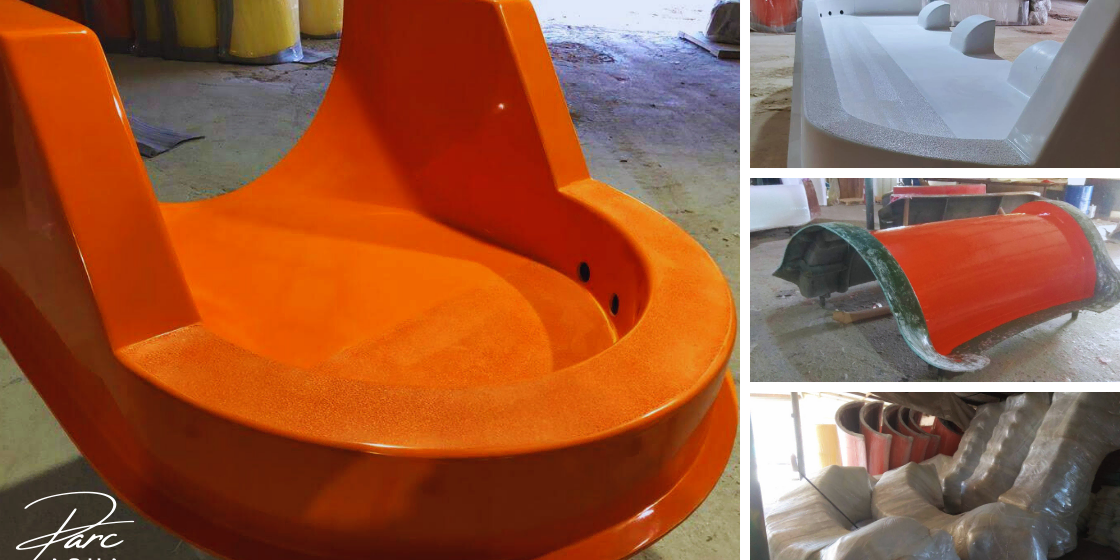
Finally, the product is removed from the mold and undergoes the necessary cutting and grinding processes. For RTM molds, the product is double-sided with gelcoat, smooth, and glossy, requiring only polishing to reveal a radiant surface. Each water slide is thoroughly inspected through quality control procedures before moving to the packaging stage.
Each product is packaged with special thermoform foam and wrapping materials. Labeling is applied both on the packaging and directly on the product, marking the end of the production process.
Why Parcaqua?
At Parcaqua, we guarantee that our water slides comply with standards, are durable, and have a long lifespan. In all our production processes, we use the highest quality materials, always prioritizing customer satisfaction and safety. You can contact us for your questions.